AudioBooks Unlimited to Kindle
Cee68Books & Reference
4.0128.00 Reviews
- Version
- 1.6.9
- Installs
- 50.00K
- Age Rating
- Everyone
Screenshots
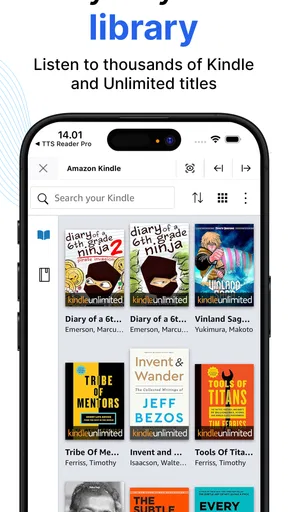
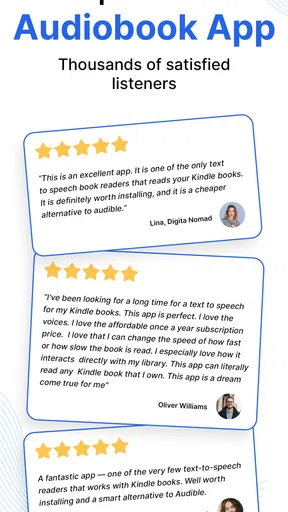
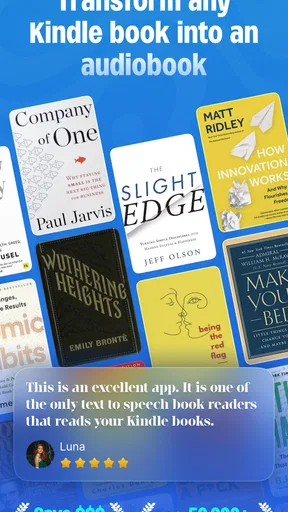
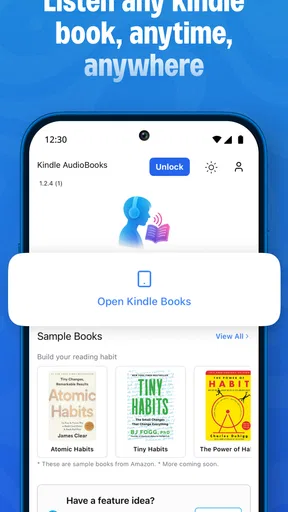
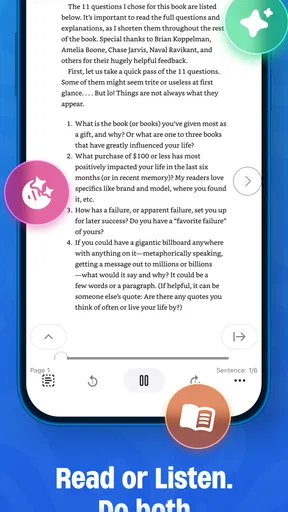
Our Review of AudioBooks Unlimited to Kindle
 Analysis by Appyee
I approached AudioBooks Unlimited to Kindle as a practical reading companion rather than a novelty app. Its promise is attractive: turn Kindle books into an audio listening experience and offer another route besides Audible. After spending time with it, my main question was not whether the idea is interesting—it is—but whether it would still earn a place in my routine after the first burst of curiosity disappeared.
The answer depends heavily on how you already read. If your Kindle library is central to your daily life and you want to move between reading and listening, this app has a clear purpose. If you mainly want a polished audiobook subscription with a predictable catalog and minimal setup, the usual dedicated services may feel more straightforward. The app sits in an unusual space between an e-book companion and an audiobook alternative, and that makes its strengths more specific than the short store summary suggests.
From an appealing first week to a useful reading habit
The first-week appeal is easy to understand. A book that normally belongs to a screen suddenly becomes something I can approach while walking, doing housework, or commuting. That change is valuable because it removes the need to reserve quiet, hands-free time for reading. Instead of abandoning a book during a busy day, I can continue it in another format and return to the page later.
That flexibility is the strongest reason to try the app. Many reading apps are built around one mode: visual reading. AudioBooks Unlimited to Kindle is more interesting when treated as a bridge between modes. I can use text for difficult passages, names, diagrams, or concentrated study, then switch to listening when I need to keep moving. For long novels and general nonfiction, that rhythm can make a large book feel less demanding.
The app belongs to the Books & Reference category, but I would not limit its usefulness to casual reading. It can suit language learners who want to hear rhythm and pronunciation alongside written words, students revisiting assigned material, and readers with limited screen time. The practical benefit is not simply “more books”; it is the ability to fit one book into more parts of the day.
My first recommendation is to begin with a title you already understand rather than the most complicated book on your list. Familiar material makes it easier to judge the listening experience, follow transitions, and notice whether the app fits your concentration style. Starting with a dense technical work can make ordinary adjustment feel like a product flaw.
Another useful early workflow is to divide reading by task. I would listen during repetitive activities, use the Kindle version when taking notes or checking a passage, and avoid switching formats in the middle of a particularly intricate argument. That small rule prevents the experience from becoming fragmented. The app is most convincing when it supports a reading plan, not when it is expected to replace every other reading method.
The free entry point also lowers the risk of trying it. The app is free to install, while in-app purchases range from $4.89 to $99.99 per item. That span matters: I would explore the basic experience first and think carefully before committing to a higher-priced purchase. A free download can be useful for testing compatibility with your habits, but it should not be treated as proof that every part of the listening catalog or workflow will cost nothing.
Its age rating is Everyone, which makes the presentation approachable for a broad audience. That does not mean every book is suitable for every listener; the content of an individual title still matters. It simply makes the app feel accessible as a general reading utility rather than a narrowly targeted specialist tool.
What makes the format more useful than it first appears
The less obvious advantage is continuity. I often lose momentum when a book is tied to one location or one device. A Kindle title that can also become a listening session has a better chance of staying active in my routine. This is especially helpful for books that are good but not urgent: the kind that might otherwise remain unopened for weeks.
There is also a psychological benefit to keeping one title in circulation. Instead of maintaining separate audiobook and e-book queues, I can think in terms of the next chapter or the next reading session. That reduces the friction of choosing what to consume. It is a small change, but long-term apps succeed through small reductions in decision-making.
Still, I would not confuse convenience with universal accessibility. Listening requires sustained attention, just as reading does, and some people process written information more accurately than spoken information. If you need to search constantly, compare paragraphs, inspect tables, or quote exact wording, the audio route will be slower. The app is a complement to Kindle-style reading, not a complete substitute for the page.
Month-to-month value, upkeep, and the points where fatigue appears
After the novelty fades, the important question becomes whether the app keeps solving a recurring problem. In my view, it can, but only if I use it as part of a stable routine. The strongest long-term scenario is a reader who regularly has otherwise unusable listening time and already owns or follows Kindle books. That person can return to the app repeatedly without needing a new reason to open it.
The weaker scenario is someone who downloads it because “every book as audio” sounds exciting but rarely listens. An app cannot create spare attention. If your schedule has no walking, commuting, cooking, or quiet listening windows, the conversion idea may remain interesting without becoming valuable. The lasting benefit comes from repeated use, not from the size of the promise.
I would judge month-to-month value by three practical questions. Do I finish more books because listening removes a bottleneck? Do I return to titles I had paused? Does switching between text and audio help me understand or remember the material? If the answer is yes to at least one of these, the app has a defensible place in my library. If the answer is no, a conventional reading app may be the cleaner choice.
The app has a 4.0 average from around 670 ratings and has passed 50,000 installs, with 128 written reviews. Those figures suggest a real user base and a generally positive reception, but I would read them as a reason to investigate rather than as a guarantee. A four-point average can hide very different experiences depending on device, book choice, listening habits, and expectations about what an audiobook service should provide.
Version 1.6.9 gives the app a current point of reference when deciding whether to try it. I would still keep expectations practical: a version number does not tell me how well the app will fit my particular workflow. The useful test is whether opening a book, beginning a listening session, and returning to the text feel simple enough that I will repeat them next week.
Maintenance is not necessarily technical maintenance. The bigger burden is organizational. I need to remember which book I am following, where I stopped, and which mode suits the next activity. If I jump between several titles, the convenience can turn into mental clutter. My solution is to keep one primary book for listening and one secondary book for close reading, rather than trying to manage an entire library in both formats at once.
This two-track method is one of the most effective ways to reduce fatigue. The listening title should be easy to follow without frequent pauses, while the reading title can be more demanding. When I expect audio to handle a book full of references, charts, or complicated structure, I create unnecessary frustration. Matching the title to the format is more important than forcing every Kindle book into the same routine.
Where the usual alternatives still have an advantage
Compared with Audible, AudioBooks Unlimited to Kindle is appealing when my starting point is a Kindle book rather than an audiobook catalog. Audible is designed around dedicated audio discovery and listening, so it may feel more natural for someone who wants narrated editions first. This app is more compelling for a reader who wants to extend an existing Kindle habit into audio.
Dedicated audiobook platforms may also be preferable when I care most about a highly curated listening experience, narrator-focused browsing, or a service built entirely around audio consumption. On the other hand, those services can encourage me to maintain a separate audio library from my e-books. The choice is therefore less about which app is universally better and more about whether my collection begins with Kindle titles or with audiobooks.
Traditional text-to-speech tools are another comparison worth making. They may be useful for accessibility or for reading content outside a particular book ecosystem, but they often feel like general-purpose utilities. AudioBooks Unlimited to Kindle has a more focused identity: it tries to make Kindle reading participate in an audio routine. I would choose the broader tool when I need many document types, and this app when Kindle books are the center of the workflow.
There is a trade-off in that focus. A specialized bridge can be easier to understand, but it may not satisfy users who want one universal player for podcasts, audiobooks, documents, and web articles. I would skip this app if my goal is to consolidate every spoken-word source into one place. Its value is strongest when the Kindle connection is the reason I am listening.
Recurring friction that can wear down a good idea
The first source of fatigue is expectation. The phrase “every Kindle book” creates a very broad mental picture, but a reader should still evaluate the experience title by title. Books are not equally suited to audio. Reference works, illustrated books, poetry with visual formatting, and heavily footnoted material can lose something when approached only through sound.
The second source is attention management. Audio lets me continue while my hands are busy, but not while my mind is fully occupied. I would not use it as background during a complicated work task and then blame the app when I miss important sections. For serious nonfiction, I prefer short listening sessions followed by a written recap. That turns passive listening into a more reliable learning process.
The third source is purchase uncertainty. Because the app is free but includes individual in-app purchases ranging from $4.89 to $99.99, I would check the cost attached to the specific option before treating it as a replacement for a subscription service. A reader who listens occasionally may find a one-time purchase sensible; a heavy listener should compare the total recurring cost with established audiobook alternatives before building a permanent habit.
That comparison should include more than price. Consider how often you finish books, whether you already own Kindle editions, and whether you need audio for titles that are not in your current library. Someone who listens to one book every few months may value the app’s flexibility. Someone who consumes audio constantly may prefer the predictable structure of a dedicated service, even if it means maintaining a separate collection.
There is also a habit-maintenance issue that is easy to overlook: switching formats can weaken recall if I never pause to consolidate what I heard. My practical fix is to stop at natural chapter boundaries and write one or two plain-language sentences about the main point. This is especially useful for nonfiction and makes the app more valuable than simply letting chapters play in the background.
For families, the Everyone rating makes the app broadly approachable, but I would still choose books together rather than assume the rating covers the material inside every title. For accessibility-focused users, audio can be genuinely helpful, yet the best experience will depend on whether the app’s particular handling of a book fits their needs. I would test a familiar title before purchasing anything substantial.
Who should keep it installed?
I would recommend keeping it installed if you already use Kindle regularly, often have periods when reading with your eyes is inconvenient, and prefer continuing the same book instead of starting a separate audiobook. It is also a good candidate for readers who struggle to finish long books because their available reading time is scattered across the day.
I would be more cautious if you mostly read visually, need exact page-level study, or expect every title to work equally well in spoken form. Students doing close analysis may want the Kindle experience first and audio only as a review tool. Likewise, readers who want a broad, polished audiobook marketplace rather than a Kindle-centered companion may be happier elsewhere.
The app is developed by Cee68, and its focused purpose is clear enough that I can explain the reason to use it in one sentence: it helps turn Kindle-centered reading into a more flexible audio habit. That clarity is a strength. I do not need it to become an all-purpose media platform for it to be useful.
My long-term verdict
After the initial novelty, I think AudioBooks Unlimited to Kindle earns lasting space for the right reader, but not automatically for everyone. Its durable value comes from reducing the gap between “I want to read this” and “I have time to read this.” When listening fits naturally into walks, chores, travel, or quiet evening routines, the app can keep books moving forward.
Its limitations are equally important. It does not remove the need to choose suitable books, protect attention, manage purchases, or maintain a sensible reading workflow. The app works best when I treat it as a bridge, not a magic conversion of every text into a perfect audiobook. That distinction prevents disappointment and makes the useful cases stand out.
My advice is to start with one familiar Kindle title, use audio only during a repeatable part of your day, and compare the cost of any purchase with how often you genuinely listen. Give the habit enough time to prove itself, but do not keep paying for convenience you are not using. If the app helps you finish books that would otherwise remain stalled, it has done something meaningful.
For me, the lasting recommendation is conditional but positive: this is worth trying when your reading life already begins with Kindle and your schedule regularly creates listening opportunities. It is less convincing as a universal replacement for Audible or for a dedicated audiobook platform. Used with realistic expectations, it can turn a familiar e-book library into a more flexible part of everyday life rather than another app that disappears after the first week.
Verdict
Strengths of AudioBooks Unlimited to Kindle
- Large audiobook catalog with titles across many popular genres.
- Simple interface makes browsing and starting books quick.
- Useful playback controls, including speed adjustment and sleep timer.
- Supports listening while commuting, exercising, or doing other hands-free tasks.
- Can complement Kindle reading with audio versions of selected books.
Limitations of AudioBooks Unlimited to Kindle
- Catalog availability may vary by country and licensing agreements.
- Some titles may require an additional purchase or subscription.
- Audio quality and narration can differ noticeably between books.
- Offline listening may require downloading titles before leaving Wi-Fi.
- Background playback can increase battery and mobile data usage.
Similar Picks in This Category
View All
Google Play Books & Audiobooks
Google LLC4.7

네이버 - NAVER
NAVER Corp.3.5

Wattpad - Read & Write Stories
Wattpad.com3.7

King James Bible - Verse+Audio
Ozion4.8

Bible Offline-KJV Holy Bible
Bíblia Offline4.9

Amazon Kindle: Reading App
Amazon Mobile LLC4.8
Frequently Asked Questions
What is AudioBooks Unlimited to Kindle?
AudioBooks Unlimited to Kindle is an app designed to help users discover, access, and manage audiobook content on compatible Kindle devices or through supported Kindle services. Its usefulness depends on the specific Kindle model, account region, and available integrations. Before downloading, check the app description carefully to confirm whether it supports your device and whether it provides audiobooks directly or works as a companion tool for Kindle content.
Can I listen to audiobooks directly on my Kindle device?
Whether you can listen directly on a Kindle depends on the model and software version. Some Kindle devices support Bluetooth headphones or speakers and audiobook playback, while others are intended mainly for reading. After installing AudioBooks Unlimited to Kindle, review the connection instructions and confirm that your Kindle is compatible. You may also need to use the same Amazon account on both the app and the Kindle.
Does AudioBooks Unlimited to Kindle offer free audiobooks?
The app may include free titles, previews, subscription-based access, or links to audiobook services, depending on your location and the current version. “Unlimited” should not automatically be interpreted as every audiobook being free without restrictions. Check the pricing information, trial conditions, renewal terms, and catalog limitations before starting a subscription or entering payment details, especially if the app redirects you to an external service.
Is AudioBooks Unlimited to Kindle available for Android and iPhone?
Availability can differ between Android and iOS, and some features may not be identical across platforms. Before downloading, verify that your phone meets the required operating system version and that the app is offered in your country’s official store. Kindle compatibility is also separate from phone compatibility, so confirm whether the app synchronizes playback, downloads, bookmarks, or reading progress with your particular Kindle account and device.
Is AudioBooks Unlimited to Kindle safe to use?
Download the application only from an official Google Play Store or Apple App Store listing, and check the developer name, recent reviews, permissions, and privacy policy before installation. If the app requests unnecessary access to contacts, messages, or unrelated files, consider that a warning sign. Also use a secure Amazon account login, avoid sharing passwords, and review subscription permissions before approving any purchase.
